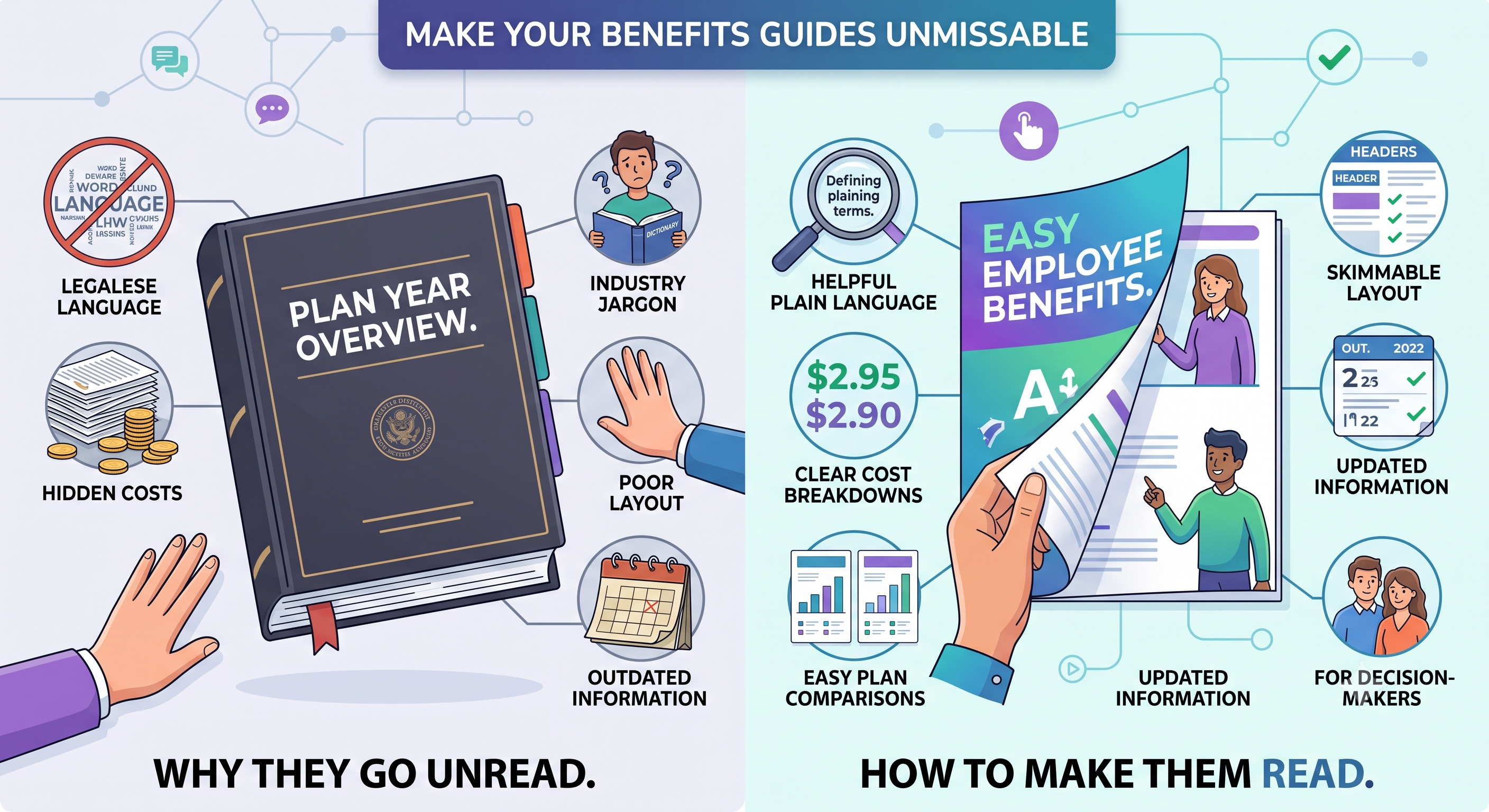
Employers spend real money assembling benefit guides every year, and most of them are barely opened. After 25 years building these, the reason is almost never the benefits themselves — it's how the information is presented. A guide that doesn't get read can't do its job, no matter how complete it is.
Here's why guides go unread, and what actually changes that.
They read like legal documents, not help
The moment a guide opens with dense carrier language and compliance text, the employee's brain files it under "deal with later" — which means never. A guide should feel like someone helping, not a contract to sign.
They assume knowledge the employee doesn't have
Most employees don't know what a deductible is, how coinsurance works, or why an HSA matters. A guide written as if they already know this loses them immediately. Plain-language explanations the first time a term appears do more than any glossary.
They bury the answer to "what does this cost me?"
The single question every employee has is what each plan costs them per paycheck and what happens when they need care. If that answer isn't near the top and easy to find, the guide has failed its main job.
They're not built to be skimmed
Nobody reads a benefit guide front to back. They scan for the one thing they need. Short sections, clear headers, and a real table of contents beat a wall of text every time.
They're out of date
A guide with last year's costs or a dropped carrier erodes trust the moment an employee notices. Once they catch one error, they stop believing the rest of it.
They never reach the actual decision-maker
In many households, the spouse makes the benefits call. A guide that only lands with the employee misses the person who actually decides.
What a read guide does differently
The guides that get read share a few traits: they answer the employee's real questions first, explain terms in plain English, make costs easy to compare, and respect that the reader is busy. They're shorter, clearer, and built around the employee — not the carrier.
The bottom line
A benefit guide isn't judged by how comprehensive it is — it's judged by whether employees open it, understand it, and act on it. If yours goes unread, the problem usually isn't the content. It's that it was written for compliance instead of for the person trying to choose a plan.