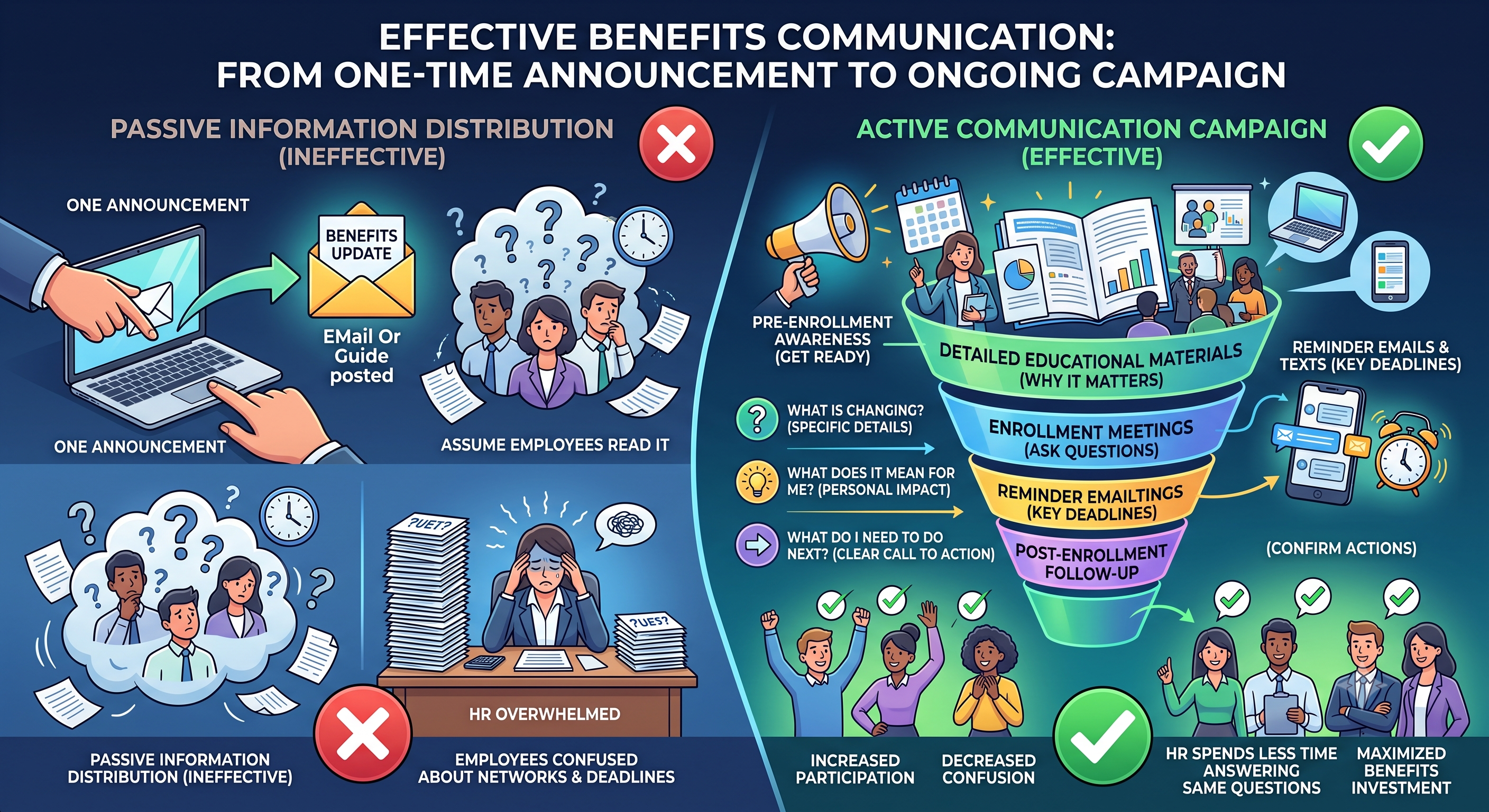
The quality of your benefits program is only as good as your communication strategy. Even the best benefits will fail to deliver value if employees don't understand them. Yet many employers still treat communication as a one-time announcement rather than an ongoing campaign designed to drive understanding and action.
Key Takeaways
Sending an email or posting a benefits guide does not equal effective communication. Success requires employees to understand what is changing, why it matters, and what action to take.
Multiple touchpoints across different channels are essential. One announcement is never enough.
Structure your communication like a marketing campaign with pre-enrollment awareness, educational materials, meetings, reminders, and post-enrollment follow-up.
Every message should answer three questions: What is changing? What does it mean for me? What do I need to do next?
What's the biggest misconception about employee benefits communication?
Many employers believe that simply sending an email or posting a benefits guide is enough to communicate effectively. In reality, communication only succeeds when employees understand what is changing, why it matters, and what action they need to take.
The difference between distributing information and ensuring understanding is significant. One is passive; the other requires intentional design.
When does poor communication cause real problems?
In my experience, communication breakdowns become visible quickly during times of change. I worked with an employer that was changing medical carriers during open enrollment. Leadership assumed employees would read the enrollment materials on their own.
After the initial announcement, employees became confused about provider networks, ID cards, and enrollment deadlines. The result was a flood of HR questions that overwhelmed the department and created unnecessary stress.
We implemented a structured communication campaign that included announcement letters, benefit guides, enrollment meetings, reminder emails, and FAQs. Employee understanding improved significantly. HR received fewer repetitive questions, and enrollment was completed on time.
What mistake do employers make most often?
Most employers communicate too little and too late. They announce changes once, assume everyone saw the message, and move on.
Effective communication requires multiple touchpoints delivered through different channels before, during, and after open enrollment. People absorb information differently. Some prefer written materials they can review at their own pace. Others need the opportunity to ask questions in a meeting. Many benefit from reinforcement through reminders.
Single-channel, single-instance communication fails because it ignores how people actually process information in a busy workplace.
How should you approach employee benefits communication?
Treat employee communication like a marketing campaign instead of a single announcement. This mindset shift changes everything about how you plan, execute, and measure your communication efforts.
Build a communication timeline
Develop a structured timeline that includes:
Pre-enrollment awareness to prepare employees for what's coming
Detailed educational materials that explain options and choices
Enrollment meetings where employees can ask questions
Reminder emails to keep deadlines top of mind
Text messages when appropriate for time-sensitive updates
Post-enrollment follow-up to confirm next steps and answer lingering questions
Answer the three critical questions
Every communication should answer three questions clearly and concisely:
What is changing? Be specific about the change. Vague language creates confusion.
What does it mean for me? Employees need to understand the personal impact. Will their coverage change? Do they need to select a new provider? Will their costs be different?
What do I need to do next? Clear calls to action eliminate ambiguity. Include deadlines, links, phone numbers, and any other resources employees need to take the next step.
Use multiple channels strategically
Different employees will engage through different channels. Some check email religiously. Others rarely open work messages but respond to text alerts. Some prefer to attend meetings where they can ask questions face to face.
A multi-channel approach ensures you reach employees where they are most likely to pay attention. Repetition across channels reinforces key messages without becoming noise.
What results can you expect from better communication?
When employees receive consistent, easy-to-understand messaging, three things happen. Participation increases because employees know what to do and when to do it. Confusion decreases because questions are answered proactively through your materials. HR spends less time answering the same questions repeatedly because the information is clear and accessible.
Better communication doesn't just make open enrollment smoother. It increases the return on your benefits investment by ensuring employees actually use and appreciate what you offer.
Frequently Asked Questions
How many times should we communicate about benefits during open enrollment?
In my experience, effective communication requires multiple touchpoints delivered through different channels before, during, and after open enrollment. A single announcement is never sufficient. Plan for an initial awareness message, detailed educational materials, enrollment meetings, multiple reminders as deadlines approach, and post-enrollment confirmation. The exact number depends on the complexity of your changes and the size of your workforce, but fewer than five touchpoints usually leaves gaps.
What should every benefits communication include?
Every communication should answer three essential questions: What is changing? What does it mean for me? What do I need to do next? When these questions are answered clearly, employees have the information they need to make decisions and take action. Without clear answers to all three, confusion and inaction follow.